Motion For Dismissal And Other Actions
State of New Hampshire v. W. Fred Koschara
"Habitual Offender" charge arising from an incident on
July 30, 1999
Motion
The Defendant, W. Fred Koschara, moves that this charge be dismissed, that the finding of Habitual Offender lodged against the Defendant by the Department of Safety be vacated, and that the provisions of RSA 259:39 and RSA 263:1 be declared null and void, on the grounds that:
- The State has attempted to deprive the Defendant of his Inalienable Rights through an assignment of Habitual Offender status without Due Process of Law;
- The officials within the Department of Safety used unconstitutional and fraudulent allegations as their grounds for finding the Defendant to be a Habitual Offender;
- The statutory definition of the term Habitual Offender is itself unconstitutional;
- The alleged requirement for anyone driving on the public roads in the State to carry a license to do so is a Constructive Fraud that further attempts to deprive the populace of their Inalienable Rights.
Arguments
I. Deprivation of Inalienable Rights without Due Process of Law
The Defendant contends that the State has attempted to deprive the Defendant of his Inalienable Rights without Due Process of Law on the basis that the Director of Motor Vehicles and his Subordinates, being members of the Executive branch of the government, have usurped the authority of the Judicial branch by passing judgment; and that, further, they are abusing their governmental authority in attempting to prevent the Defendant from exercising his inalienable rights by means of their wrongful judgment.
Article 72-a of the New Hampshire State Constitution describes the Judiciary Power for the state:
[Supreme and Superior Courts.] The judicial power of the state shall be vested in the supreme court, a trial court of general jurisdiction known as the superior court, and such lower courts as the legislature may establish under Article 4th of Part 2.
According to Webster's Ninth New Collegiate Dictionary, published by Merriam-Webster, Inc. and copyright 1988, "judicial" and "executive" are defined as follows:
judicial - 1 a: of or relating to a judgment, the function of judging, the administration of justice, or the judiciary b belonging to the branch of government that is charged with trying all cases that involve the government and with the administration of justice within its jurisdiction
executive - 2 a: of or relating to the execution of the laws and the conduct of public and national affairs b: belonging to the branch of government that is charged with such powers as diplomatic representation, superintendence of the execution of the laws, and appointment of officials and that usu[ally] has some power over legislation (as through veto)
The Director of Motor Vehicles, and his subordinates, in passing judgment of anyone on the basis of their driving record, have blatantly overstepped the bounds of their authority as defined by the New Hampshire State Constitution, which provides that the judicial power in the state belongs in the courts, not the executive branch of the government. Since their act of judging the Defendant to be a Habitual Offender was effected without a trial, lacking the Due Process of Law required for such a proceeding, it is therefore unconstitutional, and the Defendant requests that the case be dismissed as Unconstitutional under the New Hampshire State Constitution.
II. Unconstitutional and Fraudulent Allegations as Grounds for Finding
There are two things a person comes into this world with that they can claim as being intrinsically their own - the goods they have to trade with the world around them for every thing else they want or need to sustain their life. The two things are Time and Ability. Any entity - whether a person or an organization (such as a government) that seeks to deprive a person of either their time or their ability, without just cause, is attempting to commit a crime against that person.
The speed limit laws enforced in this country directly deprive motorists of both their time and their ability, then further demand the "offender" pay fines and increased insurance rates, and potentially subject them to other, more destructive burdens - including the possibility of incarceration - simply because they tried to make the best use of their time that they could.
It is NOT a valid argument to say that these actions are necessary to prevent accidents: Such an action would be a case of prior restraint. In numerous cases, the United States Supreme Court has ruled that prior restraint is unconstitutional: The government cannot restrain a person from doing something that might be illegal, but can only act after the fact. Prior restraint is also unjustifiable when examined logically: Why should a person be punished for the possibility they might commit a crime? If that is going to be done, we should outlaw the use of silverware - because a diner might pick up a fork and stab their neighbor. Further, we should also outlaw chairs, because someone might pick one up and club another person with one. For that matter, we should just outlaw civilization and get it done with, because without social intercourse, there would be no danger of human interaction - which is the only time crimes are committed by one person against another.
Another argument that has been used to justify the speed enforcement is statistical observation has shown speeding drivers are more likely to have accidents than ones traveling at more sedate paces. This is FRAUD. Any competent mathematician will testify that statistics is a branch of mathematics useful for observing and characterizing the past behavior of large groups; it is totally useless for predicting the future behavior of an individual - which is exactly what is being done in this case.
When motorists are subjected to speed enforcement because of statistical observations, they are being punished for crimes committed by other drivers - not their own. This is a perversion of justice, and cannot be allowed to stand.
The Fourth Amendment to the United States Constitution states that:
The right of the people to be secure in their persons, houses, papers, and effects, against unreasonable searches and seizures, shall not be violated, and no Warrants shall issue, but upon probable cause, supported by Oath or affirmation, and particularly describing the place to be searched, and the persons or things to be seized.
The New Hampshire Revised Statutes, Annotated, Title 21, Chapter 265, Section 4 (commonly known as RSA 265:4) decrees:
Disobeying an Officer.
- No person, while driving or in charge of a vehicle, shall:
- Refuse, when requested by a law enforcement officer, to give his name, address, date of birth, and the name and address of the owner of such vehicle;
- Give a false name, date of birth, address, name and address of the owner of such vehicle, or any other false information to a law enforcement officer that would hinder the law enforcement officer from properly identifying the person in charge of such motor vehicle;
- Purposely neglect to stop when signaled to stop by any law enforcement officer who is in uniform or who displays his badge conspicuously on the outside of his outer coat or garment, or who signals such person to stop by means of any authorized audible or visual emergency warning signals; or otherwise willfully attempt to elude pursuit by a law enforcement officer by increasing speed, extinguishing headlamps while still in motion or abandoning a vehicle while being pursued;
- Refuse, on demand of such officer, to sign his name in the presence of such officer;
- Refuse, on demand of such officer, to produce his license to drive such vehicle or his certificate of registration or to permit such officer to take the license or certificate in hand for the purpose of examination;
- Refuse or neglect to produce his license when requested by a court or justice, or refuse to surrender to the director or to any authorized employee of the department or other authorized representative of the director any license, registration certificate or number plate upon demand after suspension or revocation of the same.
- Any person who violates the provisions of paragraph I of this section shall be guilty of a misdemeanor and may have his license or privilege to drive and any registrations issued in his name suspended. If any person other than the driver of the pursued vehicle sustains personal injury in a collision resulting from the driving of a vehicle which is evading pursuit by a law enforcement officer, the driver of such pursued vehicle shall be guilty of a class B felony.
Since paragraphs (a), (c), (d), and (e) appear to allow a law enforcement officer to demand unwarranted access to a person, their papers, and their possessions at whim, and without cause, these sections of RSA 265:4 are a unconstitutional under the United States Constitution.
According to Webster's Ninth New Collegiate Dictionary, (as previously referenced), "misdemeanor" is defined as:
misdemeanor - 1 : a crime less serious than a felony
The Sixth Amendment to the United States Constitution states that:
In all criminal prosecutions, the accused shall enjoy the right to a speedy and public trial, by an impartial jury of the State and district wherein the crime shall have been committed, which district shall have been previously ascertained by law, and to be informed of the nature and cause of the accusation; to be confronted with the witnesses against him; to have compulsory process for obtaining witnesses in his favor, and to have the Assistance of Counsel for his defense.
In addition, Article 15 of the New Hampshire State Constitution provides:
[Right of Accused.] No subject shall be held to answer for any crime, or offense, until the same is fully and plainly, substantially and formally, described to him; or be compelled to accuse or furnish evidence against himself. Every subject shall have a right to produce all proofs that may be favorable to himself; to meet the witnesses against him face to face, and to be fully heard in his defense, by himself, and counsel. No subject shall be arrested, imprisoned, despoiled, or deprived of his property, immunities, or privileges, put out of the protection of the law, exiled or deprived of his life, liberty, or estate, but by the judgment of his peers, or the law of the land; provided that, in any proceeding to commit a person acquitted of a criminal charge by reason of insanity, due process shall require that clear and convincing evidence that the person is potentially dangerous to himself or to others and that the person suffers from a mental disorder must be established. Every person held to answer in any crime or offense punishable by deprivation of liberty shall have the right to counsel at the expense of the state if need is shown; this right he is at liberty to waive, but only after the matter has been thoroughly explained by the court.
The Defendant recorded the following in his notes on January 28, 1998, starting at 4:15AM, following a trial in Salem District Court:
Sitting in court, listening to the process, I could see I had a "hanging" judge in front of me: No matter what evidence or argument *anyone* put up in their defense, they *all* were found guilty and a sentence imposed. All of the court cases were done before they called me, except that the prisoners were being brought in from the station, according to comments made by the court staff.
The clerk called for "William Koschara" as I expected they would, and I got up saying I didn't think it was appropriate for them to be calling my father in their court. After I'd made it clear I thought their attempts to rename me were wrong, the judge asked the prosecuting attorney if the state was ready to proceed, and she said they were. As the first officer that had stopped me started to the stand, I interrupted to say I wanted to know if there were charges against me in the court, and if so, I wanted to know what they were. That slowed them down a bit, and I was finally presented with tickets citing the charges against me. The judge didn't want to wait, but said I could sit down and read the tickets and they'd call me back to the stand.
After clearing a couple of the other people from the room (I guess there might actually have been two or three people that were still waiting when I was first called), they brought me back up. I said that since I hadn't been informed of the charges against me prior to that time, I had not been able to adequately prepare my defense, and asked for some time to do so. The judge said I should have asked, and the prosecutor said I should have called their office, and the judge announced they were going ahead anyway. This, I was prevented from obtaining the services of an attorney, even if I wanted to.
Since it was quite clear this court was intending to railroad a conviction through, no matter what I said or did - unless I gave the judge a chance to lock me up for "contempt" as he would probably liked to have done - I decided to sit down and let them have their farce.
The woman cop - Ms. June Frechette (as indicated by the tickets I received) - presented her story, which, for the most part, was fairly accurate. Two points of misinformation stand out: She said she was following "several" cars when she turned to follow me when she left her position in front of the dog track - where I was the only car on that part of the road, and she said I had first started to allow them to put me in handcuffs, then pushed away in an attempt to resist. The other cop, Officer Decker, or Becker (I don't recall his name exactly, and I wasn't given any papers with it on it), said he had been traveling south on Route 28 when he fell in with the other officer to follow me. (I think a transcript of the radio broadcasts for the night would probably reveal that to be an inaccurate statement - made under oath). He also said I put up my hands to prevent them from being restrained with their handcuffs, and that he had to throw me against the car so Ms. Frechette could put the cuffs on. He also said I had told him that everybody had to call me "the wizard" when he was putting me in the patrol car - which is a _complete_ fabrication: The only way "wizard" had come up in relation to me that evening is the business card I pulled out of my pocket and handed them in the police station happened to be one that has my name, phone number, and the title "Wizard" on it. At _no time_ during the course of the incident did I ask them, or anyone else, to address me as, or call me "wizard."
Once this officer got done making his statement, I asked, in cross examining him, when it was that I had said I should be called "wizard" - and he again said it was when he was putting me in the patrol car. I asked him if he intended to stick to that statement, under oath, and if he would be willing to subject himself to a polygraph test of his testimony. The prosecutor announced "objection" and the judge said "sustained" (I'd like to know *what* the objection is - which they never stated - I should have asked at the time), so I said if the witness is going to be allowed to lie on the stand, there's nothing more I have to ask him.
I was then allowed to take the stand. I said I had gone home that night, and sat down at my computer to take notes about the incident, and I would be reading from those notes. I summarized the first few lines by saying I had intended to go to Applebee's that night, but had ended up at the Grand China to meet a friend. I then started reading, starting with the 2:37 entry. After I'd read about 2 1/2 pages of my notes, the judge interrupted me, saying I'd gone beyond the case at hand in reading my narrative, and asked if I wanted to say anything about my driving after suspension, which I hadn't said anything about in the notes. I thought about it for a moment, then said I didn't have anything to say, so he asked me to step down from the witness stand.
Once I got back to the "defense" table, he said that based on the evidence and hearing the testimony, he was finding me guilty of disobeying a police officer, $100 fine with a $20 penalty assessment, guilty of driving after suspension, $100 fine with a $20 penalty assessment, and guilty of resisting arrest, with the sentence suspended. I was then dismissed to wait for the clerk's office to call me to collect their money.
The entire proceedings at the trial described above are unconstitutional, not only under the United States Constitution, but the New Hampshire State Constitution as well, for the following reasons:
- A misdemeanor is a crime, and the defendant in a criminal proceeding is entitled to a jury trial by the Sixth Amendment to the United States Constitution.
- The Defendant was not provided with any documents explaining the charges against him prior to his appearance in court when the trial was held, contrary to the Sixth Amendment to the United States Constitution and Article 15 of the New Hampshire State Constitution.
- The judge refused to allow the Defendant opportunity to obtain or discuss the case with counsel, once again in violation of both the Sixth Amendment to the U.S. Constitution and Article 15 of the N.H. State Constitution.
- The judge refused to allow the Defendant to present his entire defense, again violating Article 15 of the New Hampshire State Constitution.
Since any unconstitutional act does not hold the authority of law, the Defendant is not obligated to pay the fines imposed as a result of this trial. In addition, any subsequent actions taken by the government on the basis of the convictions decreed are without constitutional grounds, and therefore without authority of law.
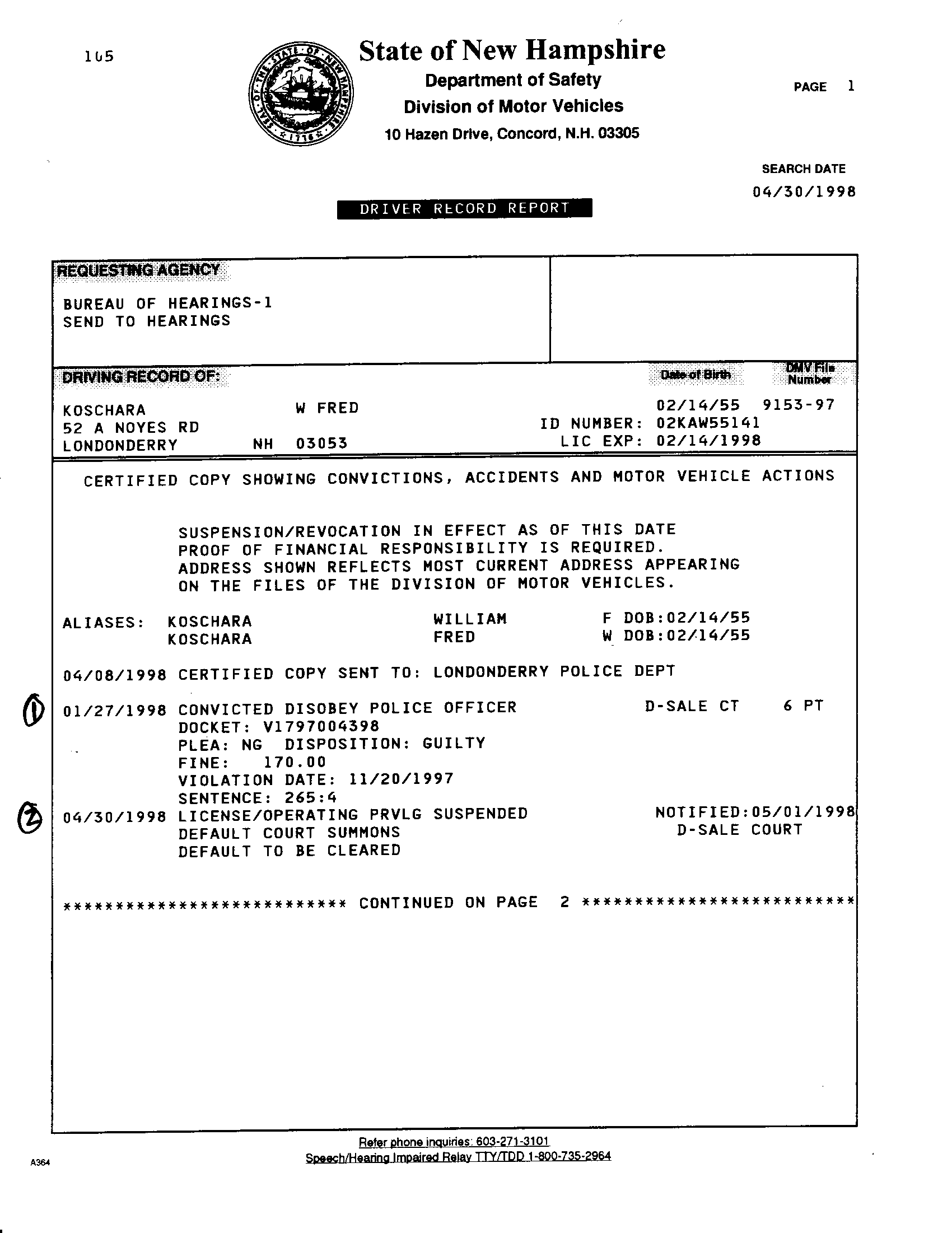
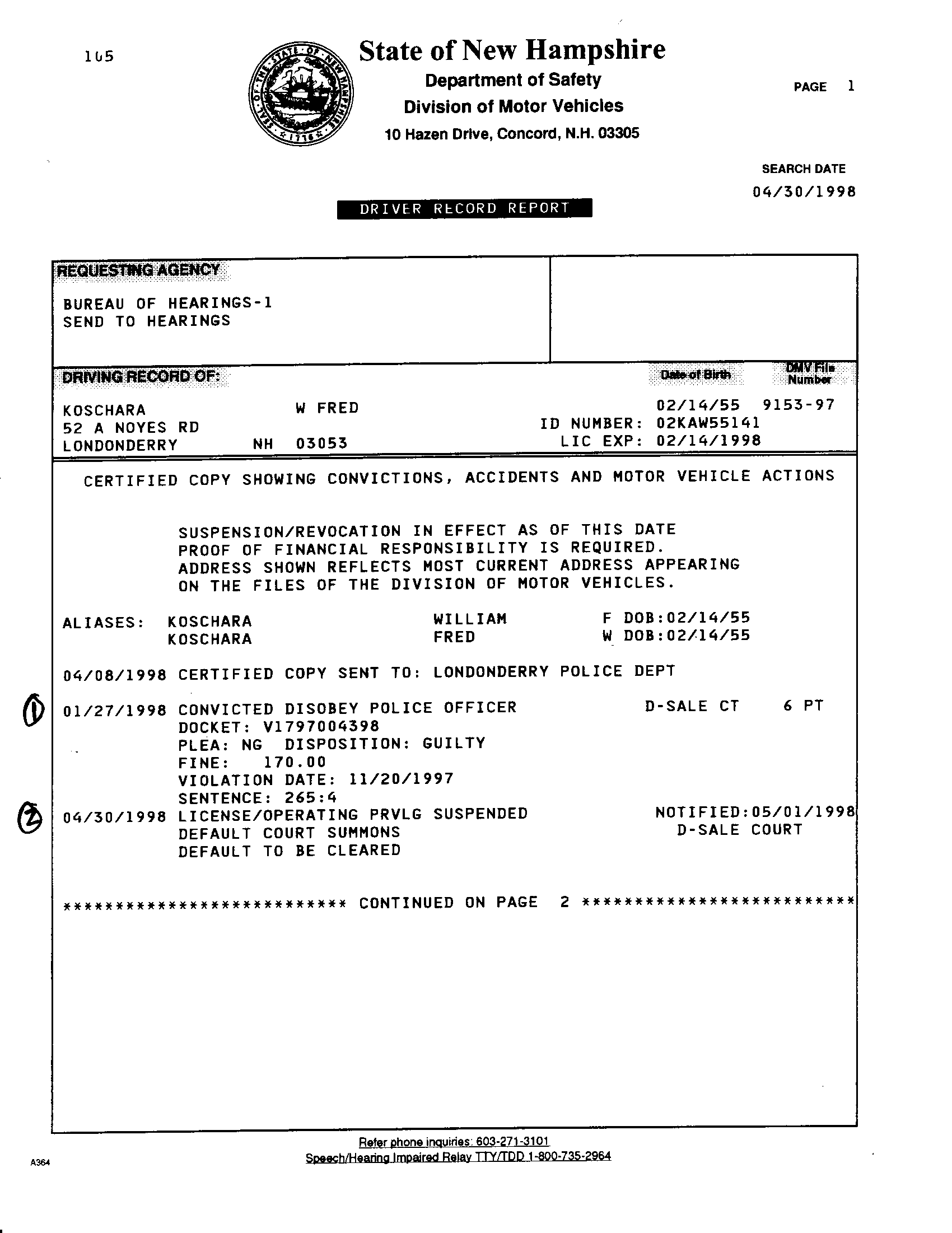
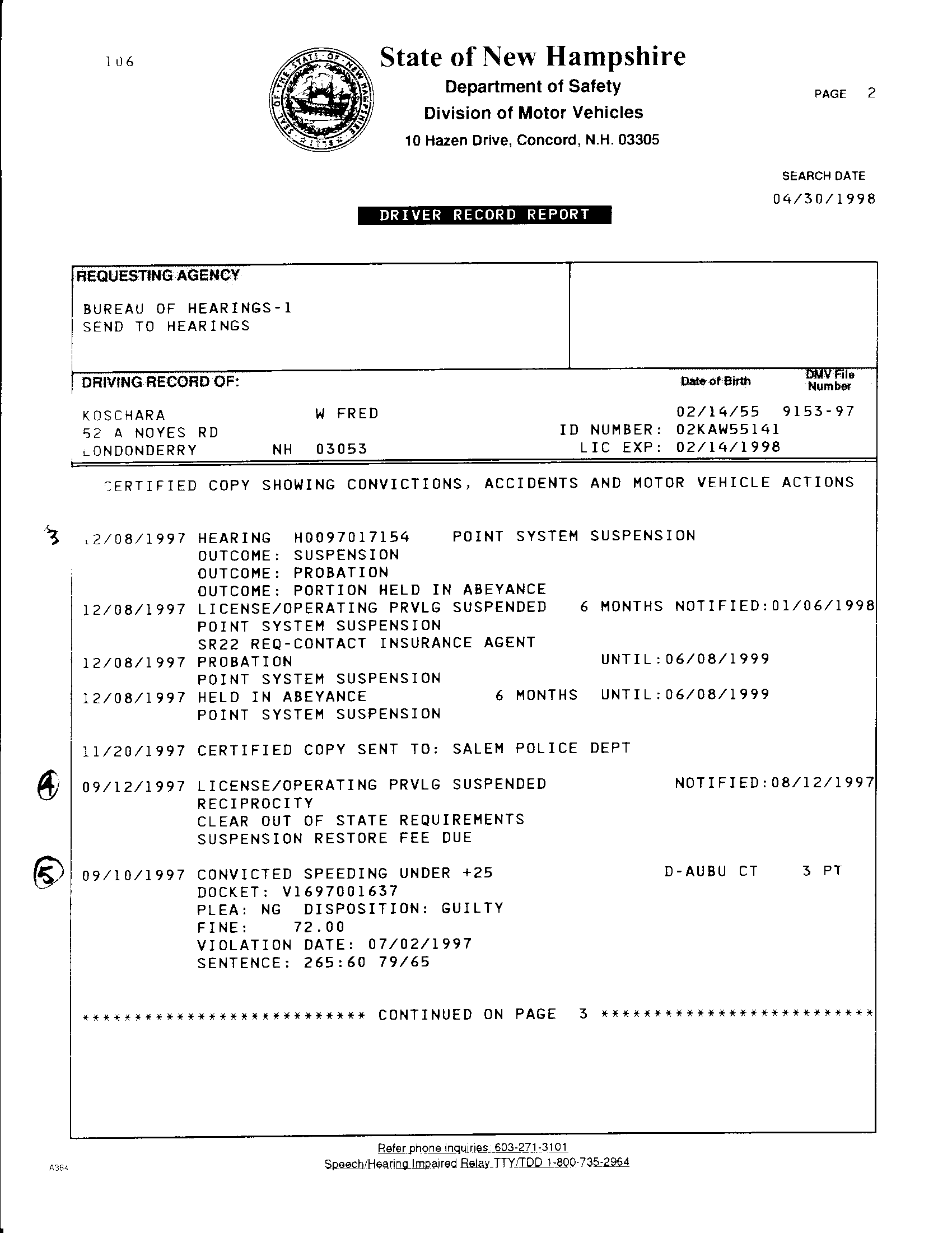
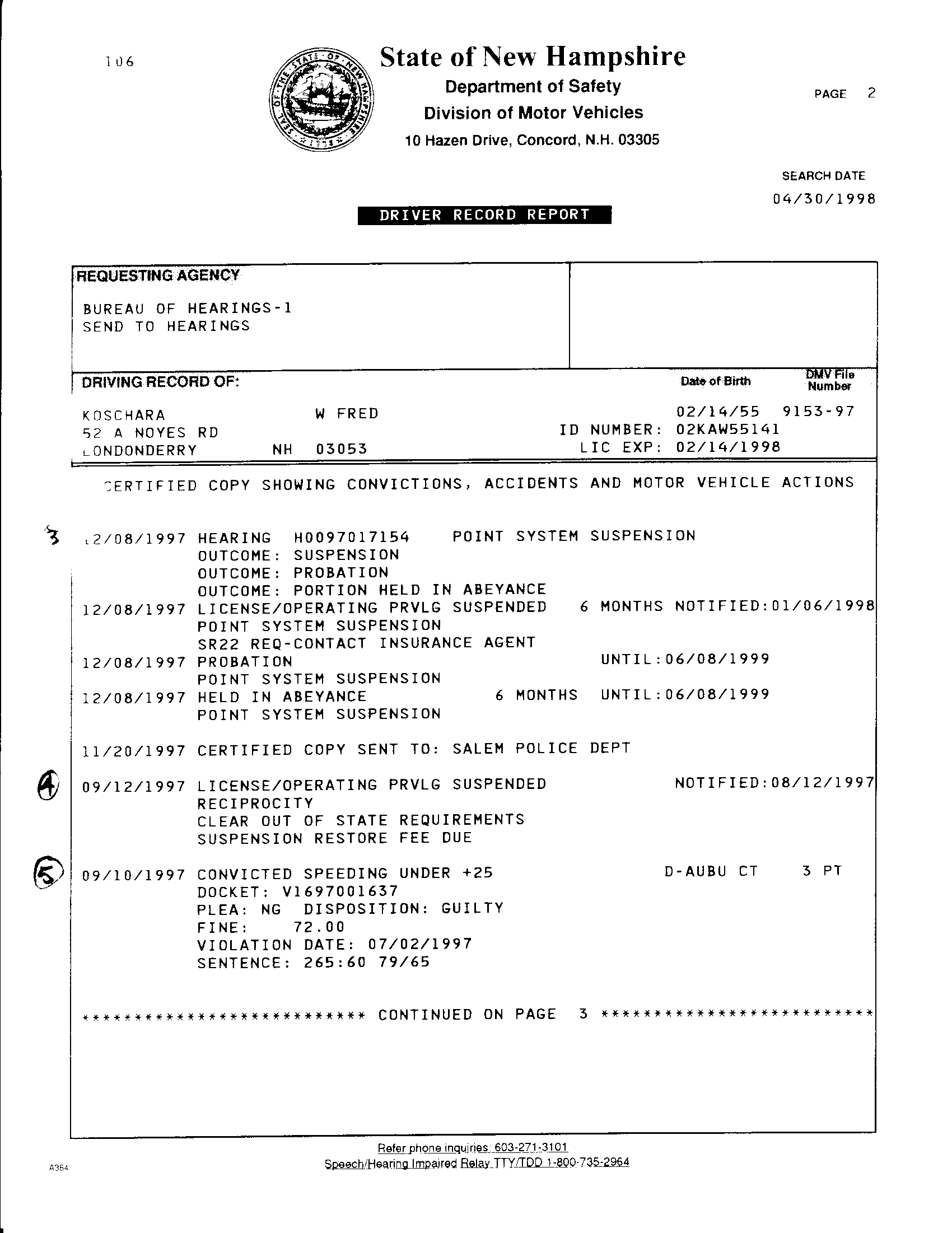
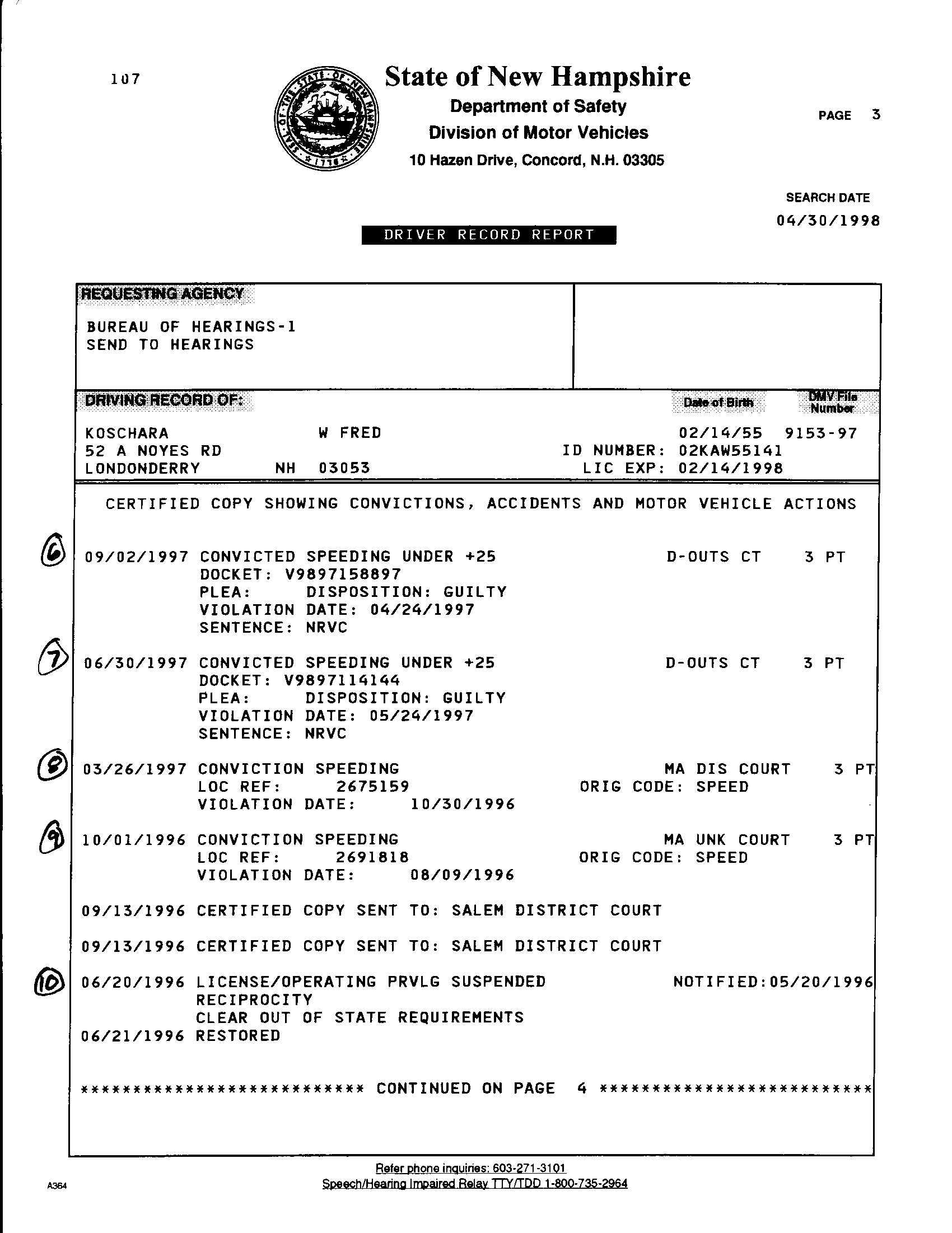
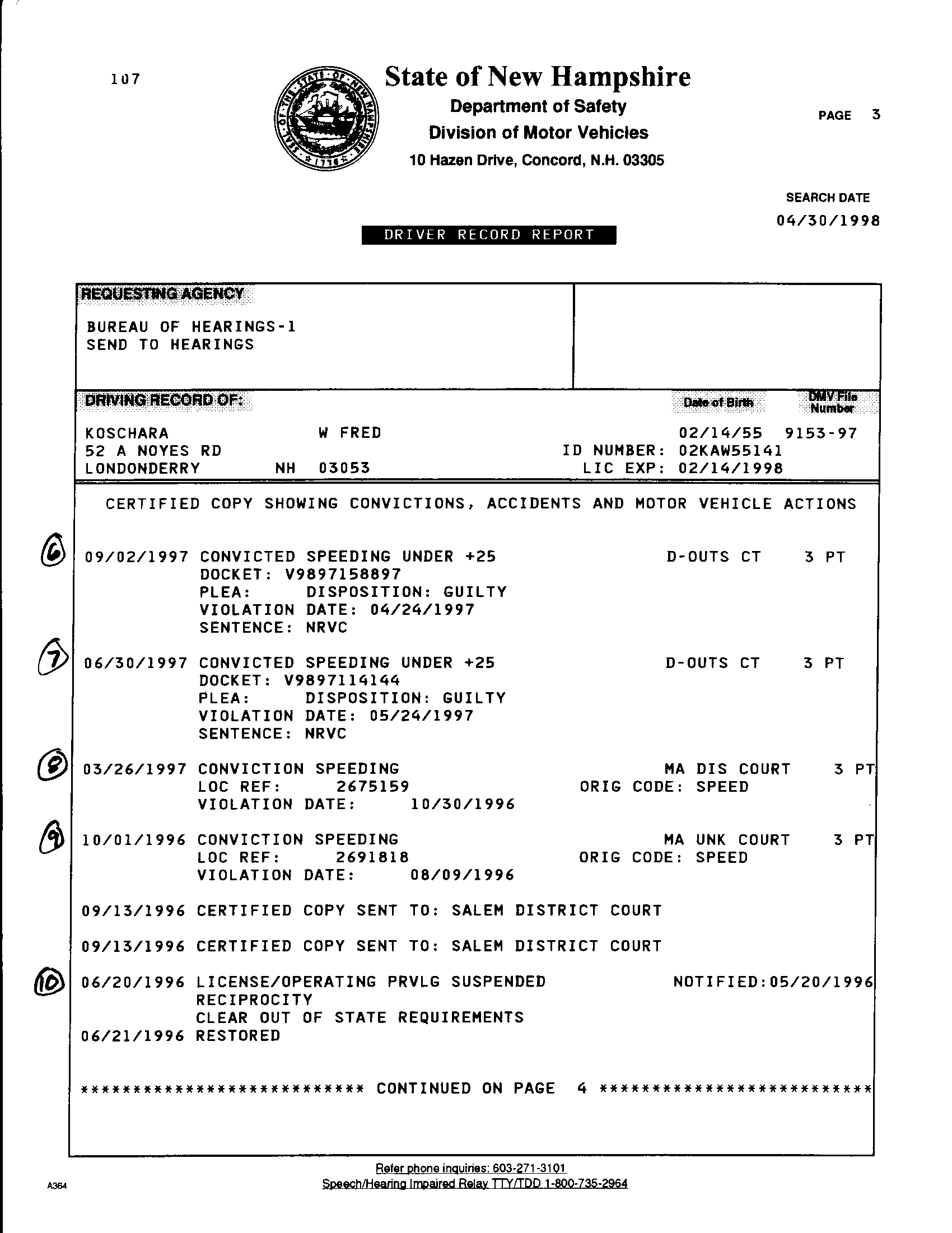
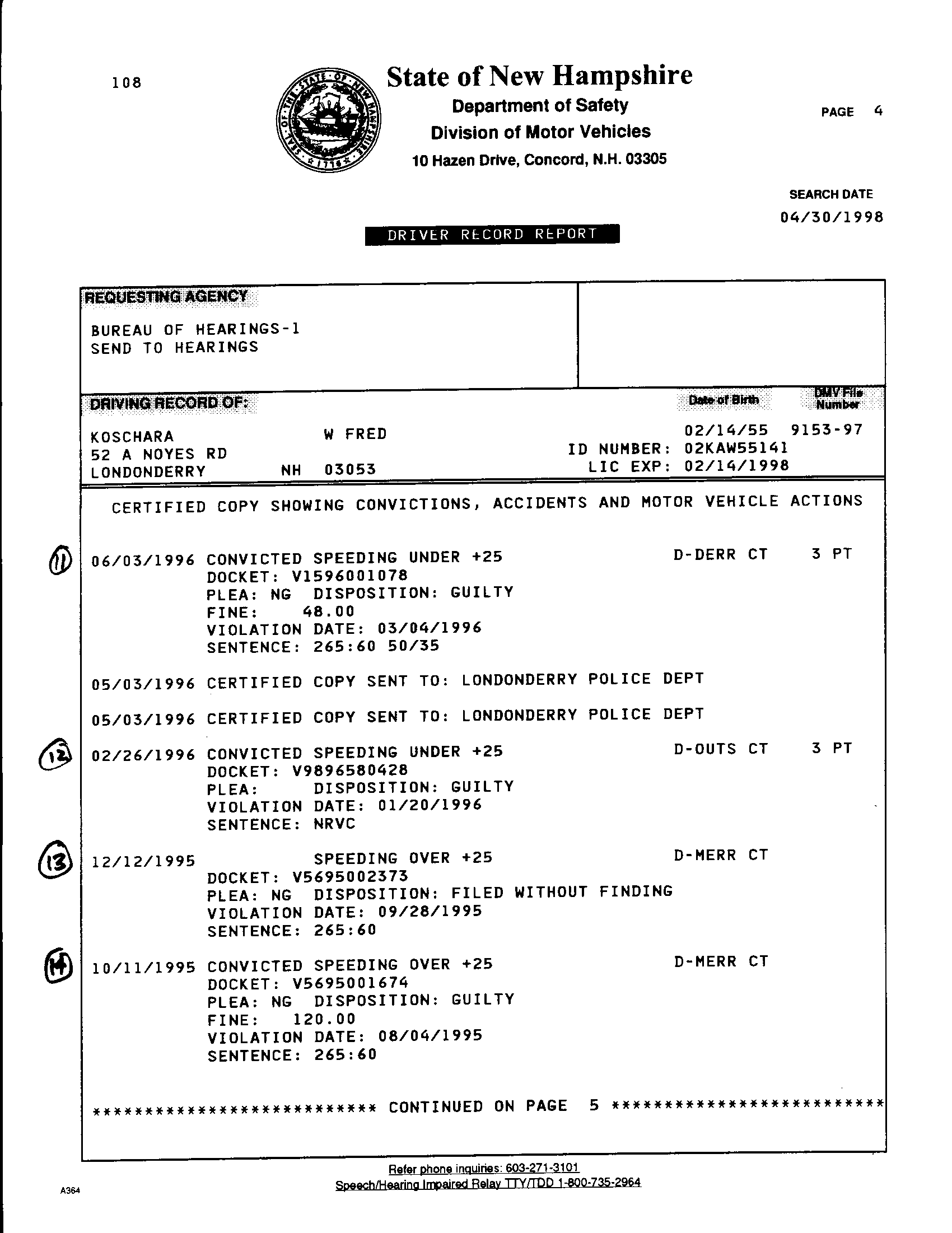
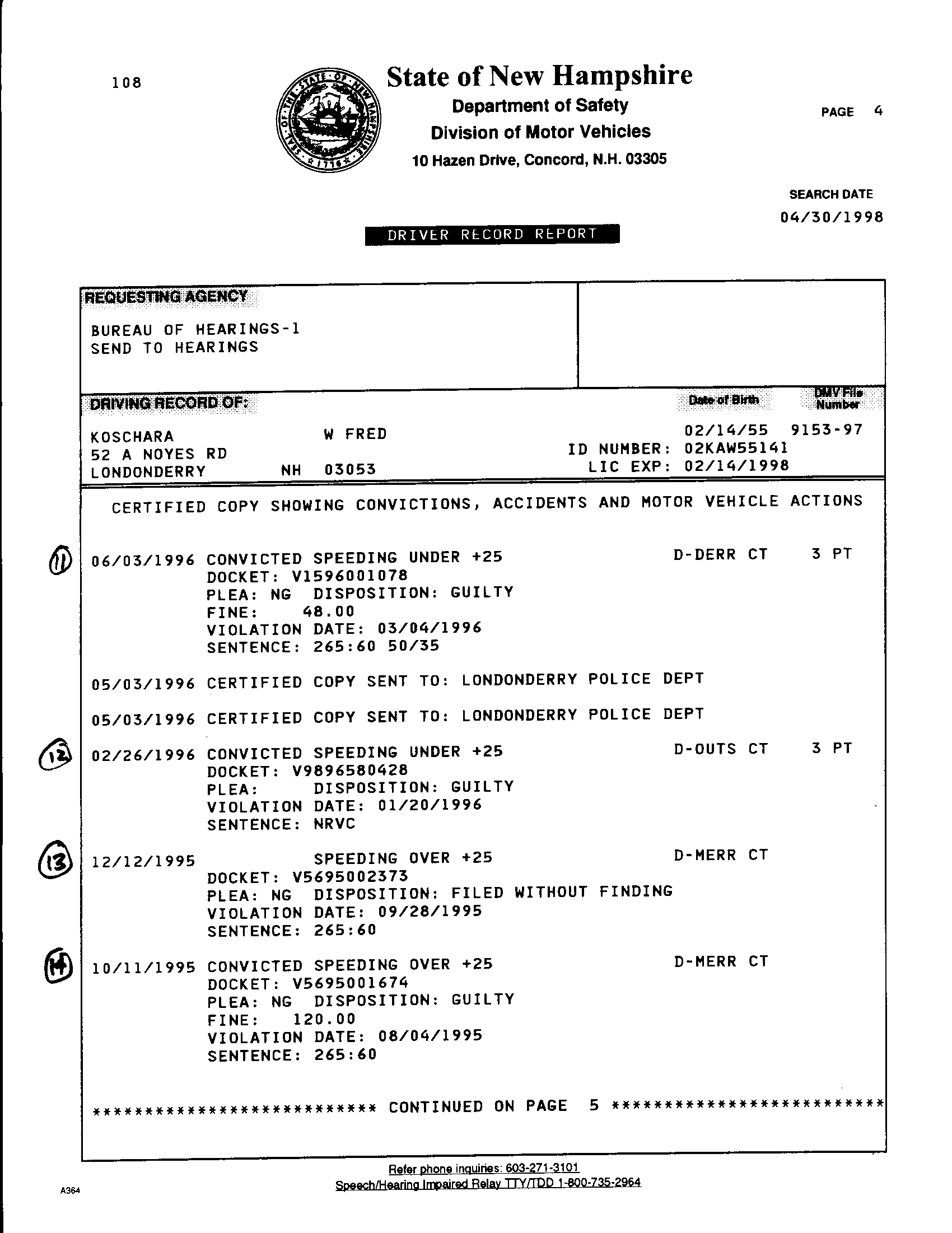
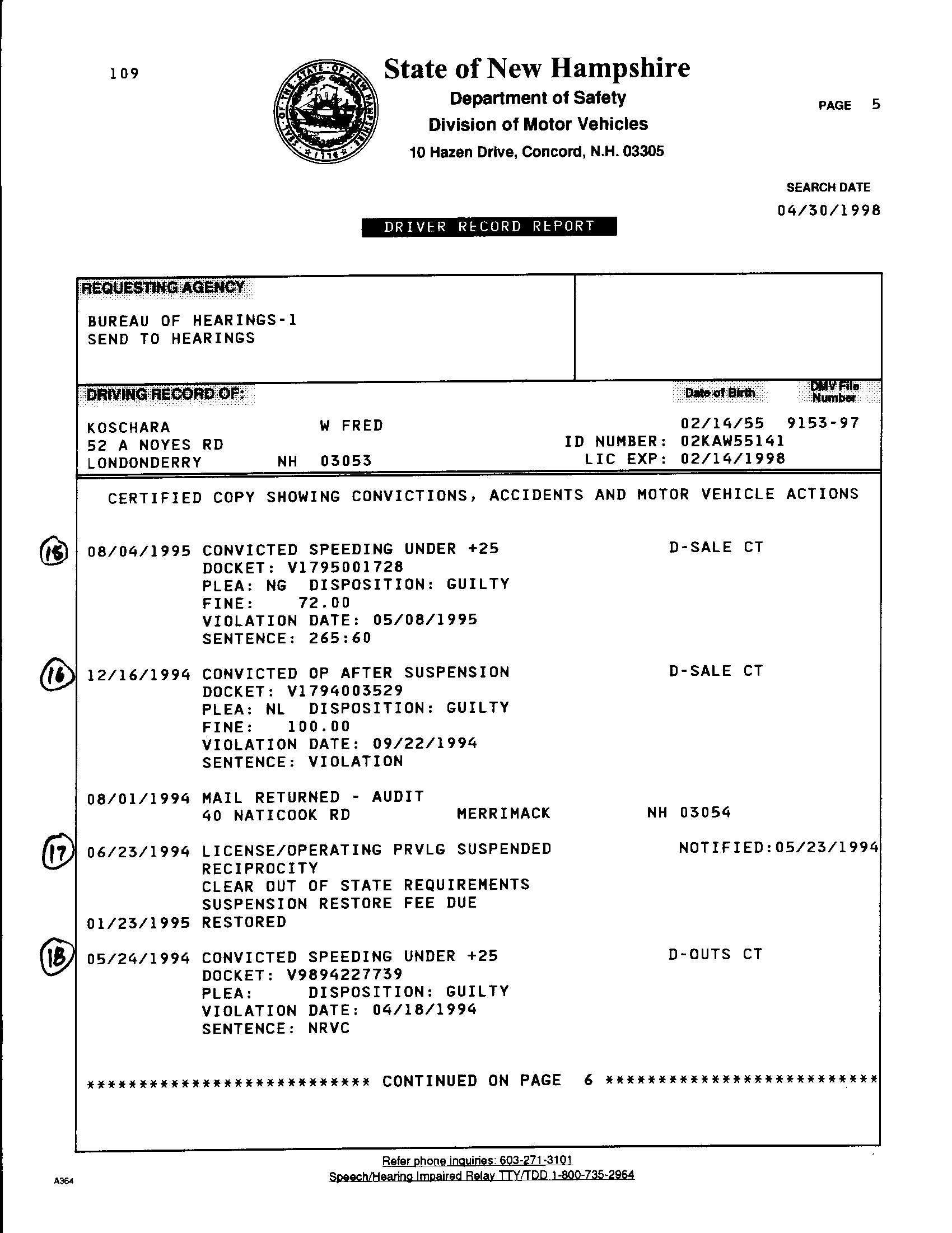
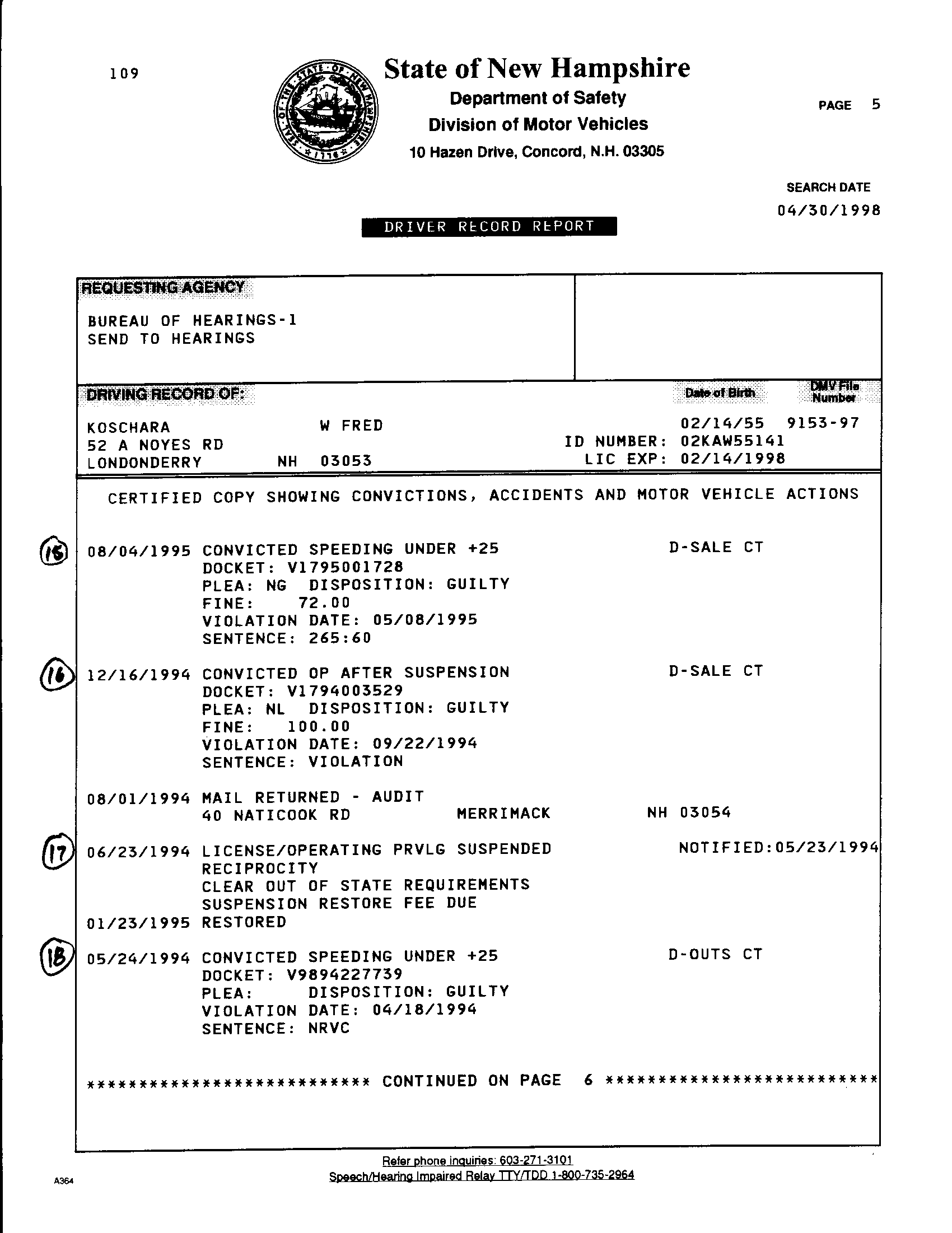
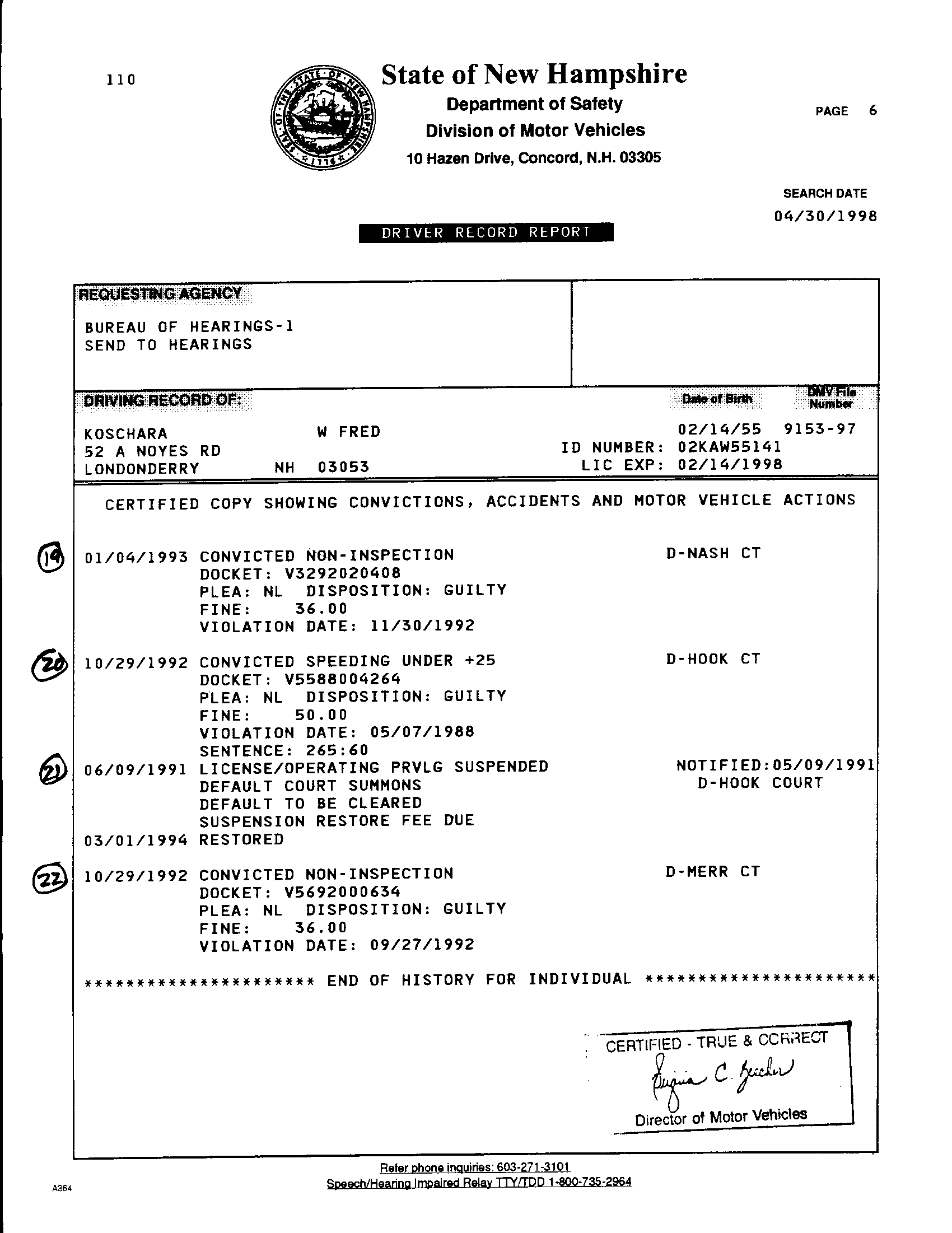
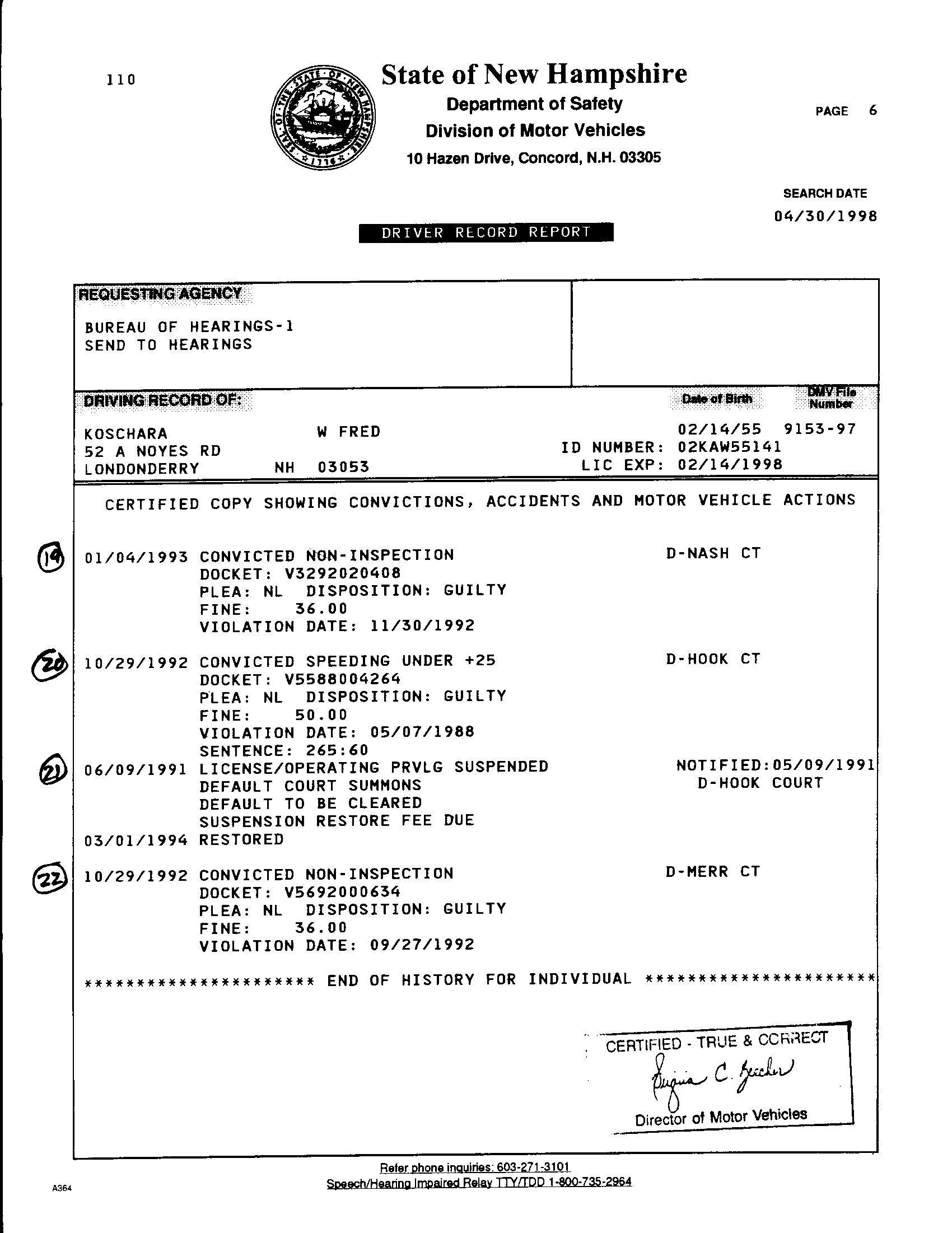
Attached to this Motion For Dismissal is an annotated copy of the six (6) page Driver Record Report the Department of Safety used in its hearing to determine the Defendant is a Habitual Offender. As can be seen by examining the Record, Items (5), (6), (7), (8), (9), (11), (12), (13), (14), (15), (18), and (20) are due to nothing more than the Defendant driving over the posted speed limits - no accidents are involved, no injuries, property damage or deaths occurred. In a word, the Defendant was simply attempting to make the best use of his time and ability, and nothing in his actions could be punished except through an unconstitutional application of prior restraint. In addition, the suspensions indicated by items (3), (4), (10), (17), and (21) are direct consequences of those speeding convictions, as is the Operating After Suspension conviction indicated at Item (16), and would not be present without said unconstitutional applications of prior restraint. Further, the conviction for Disobeying a Police Officer at Item (1) is the result of a clearly unconstitutional trial, and therefore without authority of law, and the subsequent suspension at Item (2) that resulted when the Defendant refused to pay the fine the court levied is also without legal grounds. With those items removed from the Record, all that would be left on the Defendant's driving record are the No Inspection violations at Items (19) and (22) which are definitely not sufficient grounds for making a determination of Habitual Offender. Since there are no grounds that are not unconstitutional and/or fraudulent for determining the Defendant is a Habitual Offender, the Defendant not only moves that this case be dismissed for lack of merit, but also to have the Habitual Offender status vacated by order of the Court.
III. Statutory Definition Of Habitual Offender Is Unconstitutional
Article 18 of the New Hampshire State Constitution provides that:
[Penalties to be Proportioned to Offenses; True Design of Punishment.] All penalties ought to be proportioned to the nature of the offense. No wise legislature will affix the same punishment to the crimes of theft, forgery, and the like, which they do to those of murder and treason. Where the same undistinguishing severity is exerted against all offenses, the people are led to forget the real distinction in the crimes themselves, and to commit the most flagrant with as little compunction as they do the lightest offenses. For the same reason a multitude of sanguinary laws is both impolitic and unjust. The true design of all punishments being to reform, not to exterminate mankind.
The New Hampshire Revised Statutes, Annotated, Title 21, Chapter 259, Section 39 (RSA 259:39) states:
Habitual Offender - "Habitual offender" means any resident or nonresident person whose record, as maintained in the office of the division, shows that such person has accumulated convictions in the number provided in paragraph I, II or III of this section for those offenses listed therein and committed within a 5-year period, based on the date of the offense. After a conviction for an offense listed either in paragraph I or in paragraph II and during the 5-year period, if a subsequent single incident results in convictions for more than one offense under the same paragraph, each such conviction may be counted separately for the purpose of certifying a person as an habitual offender. A person who meets the requirements of one of the following 3 paragraphs shall be certified as an habitual offender:
- Three or more convictions, singularly or in combination, of the
following offenses:
- Conviction of any offense specified in RSA 261:73;
- Conviction of any offense specified in RSA 262:1, I;
- Conviction of any offense specified in RSA 262:8;
- Conviction of any offense specified in RSA 262:12;
- Conviction of any offense specified in RSA 262:13;
- Conviction of any offense specified in RSA 263:12, V;
- Conviction of any offense specified in RSA 263:64;
- Conviction of any offense specified in RSA 264:25;
- Conviction of any offense specified in RSA 265:4;
- Conviction of any offense specified in RSA 265:79;
- Conviction of any offense specified in RSA 265:82;
- Conviction of any offense specified in RSA 265:82-a;
- Conviction under RSA 630:2 of manslaughter resulting from the operation of a motor vehicle;
- Conviction under RSA 630:3 of negligent homicide resulting from the operation of a motor vehicle;
- Conviction of any felony in which a motor vehicle is used;
- Conviction of any offense specified in RSA 265:75.
- Twelve or more convictions, singularly or in combination, of the
following offenses:
- Conviction of any offense specified in RSA 265:22.
- Conviction of any offense specified in RSA 265:60.
- Conviction of any offense specified in RSA 263:1.
- Conviction of any offense specified in RSA 263:63.
- A combination of one conviction of an offense specified under paragraph I and at least 8 convictions, singularly or in combination, of offenses specified under paragraph II; or a combination of 2 convictions, singularly or in combination, of offenses specified under paragraph I and at least 4 convictions, singularly or in combination, of offenses specified under paragraph II.
As written, this definition equates, for example, the following offenses to manslaughter or negligent homicide resulting from the operation of a motor vehicle: making a false statement relative to the payment of a resident tax (RSA 261:73); possession of master keys (RSA 262:13), lending a driver's license or permit to another person (RSA 263:12), four speeding convictions, whether any accidents were involved or not (RSA 265:60), and refusing to sign their name at the demand of an officer (RSA 265:4).
It is the sincere belief of the Defendant that this equation by law of "the lightest offenses" with "the most flagrant" is a dangerous violation of Article 18 of the New Hampshire State Constitution. The Defendant therefore moves that RSA 259:39, the definition of Habitual Offender, be found unconstitutional, and therefore null and void, at least until it has been rewritten by the Legislature.
IV. Alleged License Requirement Is a Constructive Fraud
Referring once again to Webster's Ninth New Collegiate Dictionary, (as previously referenced), "license" is defined as:
license - 1 a: permission to act b: freedom of action 2 a: a permission granted by competent authority to engage in a business or occupation or in an activity that would otherwise be unlawful b: a document, plate, or tag evidencing a license granted
Article 2 of the New Hampshire State Constitution states that:
[Natural Rights.] All men have certain natural, essential, and inherent rights - among which are, the enjoying and defending life and liberty; acquiring, possessing, and protecting, property; and, in a word, of seeking and obtaining happiness. Equality of rights under the law shall not be denied or abridged by this state on account of race, creed, color, sex or national origin.
Article 3 goes on to say that:
[Society, its Organization and Purposes.] When men enter into a state of society, they surrender up some of their natural rights to that society, in order to ensure the protection of others; and, without such an equivalent, the surrender is void.
Clearly, the authors of the State Constitution had in mind the same "certain unalienable Rights ... Life, Liberty and the Pursuit of Happiness" that were described in the Declaration of Independence signed by the Second Continental Congress on July 4, 1776. In addition, they recognized that, while it is necessary for us to surrender some of our natural rights in order for human society to function, such a surrender is only valid if an equivalent benefit is received from society in return.
If ever a judge understood the public's right to use the public roads, it was Justice Tolman of the Supreme Court of the State of Washington. Justice Tolman stated:
"Complete freedom of the highways is so old and well established a blessing that we have forgotten the days of the Robber Barons and toll roads, and yet, under an act like this, arbitrarily administered, the highways may be completely monopolized, if, through lack of interest, the people submit, then they may look to see the most sacred of their liberties taken from them one by one, by more or less rapid encroachment." Robertson vs. Department of Public Works, 180 Wash 133, 147.
The words of Justice Tolman ring most prophetically in the ears of Citizens throughout the country today as the use of the public roads has been monopolized by the very entity which has been empowered to stand guard over our freedoms, i.e., that of state government.
The "most sacred of liberties" of which Justice Tolman spoke was personal liberty. The definition of personal liberty is:
"Personal liberty, or the Right to enjoyment of life and liberty, is one of the fundamental or natural Rights, which has been protected by its inclusion as a guarantee in the various constitutions, which is not derived from, or dependent on, the U.S. Constitution, which may not be submitted to a vote and may not depend on the outcome of an election. It is one of the most sacred and valuable Rights, as sacred as the Right to private property...and is regarded as inalienable." 16 C.J.S., Constitutional Law, Sect.202, p.987.
and further...
"Personal liberty largely consists of the Right of locomotion -- to go where and when one pleases -- only so far restrained as the Rights of others may make it necessary for the welfare of all other citizens. The Right of the Citizen to travel upon the public highways and to transport his property thereon, by horsedrawn carriage, wagon, or automobile, is not a mere privilege which may be permitted or prohibited at will, but the common Right which he has under his Right to life, liberty, and the pursuit of happiness. Under this Constitutional guarantee one may, therefore, under normal conditions, travel at his inclination along the public highways or in public places, and while conducting himself in an orderly and decent manner, neither interfering with nor disturbing another's Rights, he will be protected, not only in his person, but in his safe conduct." [emphasis added] II Am.Jur. (1st) Constitutional Law, Sect.329, p.1135.
"Personal liberty -- consists of the power of locomotion, of changing situations, of removing one's person to whatever place one's inclination may direct, without imprisonment or restraint unless by due process of law." 1 Blackstone's Commentary 134; Hare, Constitution__. 777; Bovier's Law Dictionary, 1914 ed., Black's Law Dictionary, 5th ed.
Justice Tolman was concerned about the State prohibiting the Citizen from the "most sacred of his liberties," the Right of movement, the Right of moving one's self from place to place without threat of imprisonment, the Right to use the public roads in the ordinary course of life.
"Where rights secured by the Constitution are involved, there can be no rule making or legislation which would abrogate them." Miranda vs. Arizona, 384 US 436, 491.
and...
"The claim and exercise of a constitutional Right cannot be converted into a crime." Miller vs. U.S., 230 F. 486, 489.
and...
"There can be no sanction or penalty imposed upon one because of this exercise of constitutional Rights." Snerer vs. Cullen, 481 F. 946.
Streets and highways are established and maintained for the purpose of travel and transportation by the public. Such travel may be for business or pleasure.
"The use of the highways for the purpose of travel and transportation is not a mere privilege, but a common and fundamental Right of which the public and the individual cannot be rightfully deprived." [emphasis added] Chicago Motor Coach vs. Chicago, 169 NE 22; Ligare vs. Chicago, 28 NE 934; Boon vs. Clark, 214 SSW 607; 25 Am.Jur. (1st) Highways Sect.163.
and...
"The Right of the Citizen to travel upon the public highways and to transport his property thereon, either by horse drawn carriage or by automobile, is not a mere privilege which a city can prohibit or permit at will, but a common Right which he has under the right to life, liberty, and the pursuit of happiness." [emphasis added] Thompson vs. Smith, 154 SE 579.
Therefore, it is concluded that a citizen does have a "Right" to travel and transport his property upon the public highways and roads and the exercise of this Right is not a "privilege." In order for the definition of license to apply, the State would have to take up the position that the exercise of a Constitutional Right to use the public roads in the ordinary course of life and business is illegal, a trespass, or a tort, which the State could then regulate or prevent. This position, however, would raise magnitudinous Constitutional questions as this position would be diametrically opposed to fundamental Constitutional Law.
The New Hampshire Revised Statutes, Annotated, Title 21, Chapter 263, Section 1 (RSA 263:1) states:
License Required. - No person, except those expressly exempted under RSA 263:25 or other provisions of this title, shall drive any motor vehicle upon any way in this state unless such person has a valid driver's license, as required under the provisions of this chapter, for the class or type of vehicle being driven. Except as otherwise herein provided, any person who drives a motor vehicle in this state without having a valid driver's license of the appropriate class or type shall be guilty of a violation, provided that any person convicted of such offense for the second time in a 12 month period shall be guilty of a misdemeanor.
What "equivalent benefit" is offered in return for the populace giving up their right to travel on the public roads? According to the annotations for RSA 263:1, the purpose of the legislation is "to protect the public from the acts of incompetent drivers." While the intent of the law appears at first glance to be in the best interest of the public, the truth is possession of a license to drive does not make a person competent, and requiring all drivers to carry a state-issued license at best gives travelers a false sense of security.
As previously demonstrated, a citizen has the right to travel and to transport their property on the public highways in the ordinary course of life and business. However, if one exercises this right to travel the driver is guilty by statute of a crime. This amounts to the Legislature attempting the statutory conversion of the exercise of a Constitutional Right into a crime, which is void on its face. The Defendant therefore moves that RSA 263:1 be declared unconstitutional, and therefore null and void in perpetuity.
Submitted this nineteenth day of August, 1999 in the Merrimack District Court of Hillsborough County in the State of New Hampshire
W. Fred Koschara
Defendant
Annotated Copy of Fred Koschara's Driving Record
as used for determining Habitual Offender status
|
PNG Format (Smaller, faster download) |
GIF Format (Supported by more browsers) |
|---|---|
| Page 1 (37K) | Page 1 (58K) |
| Page 2 (38K) | Page 2 (62K) |
| Page 3 (41K) | Page 3 (68K) |
| Page 4 (41K) | Page 4 (67K) |
| Page 5 (39K) | Page 5 (65K) |
| Page 6 (40K) | Page 6 (66K) |